71 - How Can I Have a Healthy Sex Life and Enjoy Intimacy With Chronic Illness? A Conversation with Dr. Lisa Gray
Updated: Jun 15
Stacy Griffin: Welcome back to Autoimmune Adventures. If you're new here, we're so glad that you found us. We are three sisters, Becky, Stacy, and Alysia, and we live in the world of chronic illness and immu, autoimmunity every day. One of the things we don't talk about enough is how chronic illness can impact our closest relationships. Our partners, our spouses, the people who we love the most. And today's guest is someone who deeply understands that intersection. Lisa Gray is a psychotherapist who has worked with couples for over 20 years. And after her own diagnosis of Ehler's Danlos Syndrome, she expanded her work to focus on couples navigating chronic illness together.
Lisa has also written a book to help couples not just survive these challenges, but actually thrive. Lisa, we are so excited to have you here. Welcome to Autoimmune Adventures.

Lisa Gray: Thanks for having me. It's great to be here.
Becky Miller: Lisa, before we talk about couples, and some of the tools that you teach people, we would love to start with you specifically. So, can you tell us a little bit about your diagnosis with Ehler's Danlos Syndrome and how you found that it changed the way you understood relationships both personally and professionally?
Lisa Gray: Yeah. Um, so it was actually after I had my second child, uh, I just felt like I couldn't recover. Um, and so I started going to the doctor and Ehler's Danlos is an interesting, hypermobile Ehler's Danlos is an interesting diagnosis because so many of the things like so many autoimmune disorders like could be anything, right?
So I'd be like, ah, I have this crushing fatigue. It's like, so does everyone, you know, get more sleep or I'd be like, I can't control my weight. And they'd be like, you know, stop eating M&M's. Or I'd be like, you know, I have joint pain. Yeah, well, you're not 20 anymore. you know, so and and of course, but the way our health care system works is so siloed. So there's, you know, you're talking to all these different doctors about all these different s syndromes. And so, uh, my brother passed away in 2018 and, um, he had an aortic aneurysm, which, and I think he had Ehler's Danlos as well, possibly the vascular type. So, I was talking to my doctor about it, just my GP, and she said, "I'll tell you what. Why don't you write down every single symptom that you feel like you've ever had on one piece of paper?" So, I did that. And she read through it and she was like, "I'm going to send you to a rheumatologist." And so, um, you know, I went to the rheumatologist. They finally diagnosed me with, um, Ehler's Danlos Syndrome and chronic fatigue syndrome. Well, he was like, "You don't really have chronic fatigue syndrome, because chronic fatigue is part of Ehler's Danlos, but I'm going to put that down as well." Um, and so then I finally had the diagnosis.
And so, you know, for mo, like most people with autoimmune, this process took years. And so during that time, it's like this slow slide where like my husband and I used to hike every weekend. Well, now we can't hike. If I do the hike today that we used to do every weekend, I would throw up and have a crash for like days. you know, so um you know, there was like a lot of adjustments that had to be made. And one of the things that became interesting is like realizing how many things you never did negotiate with your spouse. Like, you know, we never talked about who did what around the house. We just kind of like fell into patterns.

Lisa Gray: We never talked about intimacy specifically. Like like it was just we just fell into patterns. So, like there's so there was so many things that just needed to be talked about and renegotiated. And thankfully, I'm fortunate to have a partner who's very, you know, understanding and loving and, you know, able to make those adjustments. But as I was experiencing it, I could see that if you did not have a partner like that, this would be very difficult.
And then I started getting all these clients coming to me where there was a component of chronic illness and just started to see the gamut of problems that you know couples could have after this occurs. So...yeah.
Alysia Thomas: That is actually so heartbreaking because it's it's a very common story and that is part, a very large part, of why we as sisters decided to do this podcast because there is a vast community of people living with chronic illness that do not have supportive partners. um do do not have supportive family even that are really trying to navigate...
Lisa Gray: Yeah.
Alysia Thomas: ...this experience of completely changing how you've had to live in your body to something very new, very different. And we hear all the time about people are just blindsided about how much it affects their relationship.
So from what you have seen, what are the first ways that chronic illness tends to show up between partners, tends to affect their relationship? Um, even when there's a lot of love there.
Lisa Gray: Well, I think one of the huge problem with autoimmune or connective tissue disease and all those things is that we all look fine. you know, like we look totally fine. You can't see joint pain. You can't see fatigue. So, I think one of the first things that I notice is that the other partner, even if they're loving, they have a hard time like believing or conceptualizing even in their mind like what their partner is going through, because they look the same as they've always looked. They look fine. And so, um, and you know, people don't fake being sick, they fake being well.

Lisa Gray: So like a lot of us, especially in the early stages, we're like doing more than we probably should be doing because we're trying to keep up with our old selves. And so our partner sees that and thinks like, well, you can do it, so why don't you do it? You know, and so like there's a lot of empathy building that needs to happen with the partners. It's like, you know, I don't need to have the same experiences as someone else to have empathy, but I do have to believe them. And so this is one of the first pieces of work is just like building that empathy for the partner to under, I mean everyone's been sick. It's like you know what it's like to be sick. Now you need to build your believe your partner muscle, so that you believe what they're telling you about what they're experiencing internally.
Alysia Thomas: And that does take a a whole different kind of mindset because especially I mean the three of us we talk about who we were before autoimmune disease and we were all women that got shit done. We still are, but we were movers, we were doers. We were goers. We were always in motion, always doing something. and learning to slow down is hard for us. But when we've been functioning at what was full capacity and our partners are now like, "um um what's what's going on here?" It's a hard adjustment. It's a hard adjustment for us.
Lisa Gray: Mhm.
Alysia Thomas: We, I still grieve over the energy I once had, over the person I once was. Um, and it's a very real grief for our partners as well because...
Lisa Gray: Yes. Yeah. I think...
Alysia Thomas: ...yes, when it's when it's for better or worse sickness and health...
Lisa Gray: Yeah.
Alysia Thomas: ...all of that. Yes. But when it that becomes reality and it affects so many parts of your life, your parenting, your career, your sex life, like all these different things that you have to adjust how you're doing them. Now your partner has to do all those same things for you.
Lisa Gray: Right? I think it makes sense to most people that if you have a chronic illness, you're grieving the life that you once had. But people forget that your partner's grieving, too. Your partner has lost the exact same amount of well, not maybe the exact same, but you know, your partner has lost the same lifestyle that you lost. And so they may be grieving in different ways. They're probably grieving different things, but you're both in a grieving process. And you both deserve compassion for the experience of going through that grieving process.

Alysia Thomas: Yeah.
Lisa Gray: Yeah.
Becky Miller: I think I think a lot of times and even when we don't intend, and I don't even say that it's anything selfish per se, when you're going through autoimmune disease, you do have this level of focusing on yourself because you're having pain. You're having all these things going on. And I think it's very easy to forget that like you said, our our partner is losing almost as much as we are if they have, you know, been with us both well and ill. I know that there are some partnerships where maybe they come into it being fully aware, but um because maybe people are already diagnosed with things, but definitely recognize that if you're grieving, give your your partner space to grieve as well.
Stacy Griffin: And even though we've discussed grief, I, I want to get really specific about a certain kind of grief that comes up and that I hear a lot about in forums, which is when we got married, our sex life was fire.
Lisa Gray: Yeah.
Stacy Griffin: It was fire. And we were having a lot of sex all the time whenever we wanted to. And now I am so exhausted. I'm so exhausted. And the spontaneity is gone, because I have to plan. We have to plan.
Alysia Thomas: And you're in pain.
Stacy Griffin: Oh yeah. And the pain and everything.
Lisa Gray: Yeah.
Stacy Griffin: You want to be able to share that part of your experience with your spouse or your partner, but it becomes a very complicated almost obstacle course of sorts to make sure that sex is something that is still...
Lisa Gray: Yeah.
Stacy Griffin: ...great for both people involved.

Lisa Gray: Yeah.
Stacy Griffin: So, what are your suggestions and thoughts on that?
Lisa Gray: Well, the first thing that I would say is that sex and intimacy are not the same thing. So, so you know, we, when we're younger, like one of the, one of the visualizations I give my clients is think back to the first person you had a huge crush on that that was reciprocated and probably you were too young to have sex. Like it maybe you were 12 or 13 or something like that, but like remember how like you made eye contact or you held hands or even your first kiss or like all of those things. Remember how intense that was like just from a like sensory perspective?. But then we get older and we get in these long-term relationships and we can have sex. So we like that becomes the main event, you know, but there are so many sensual experiences that you can have with somebody that are not intercourse. And we've forgotten that as married couples, like even healthy married couples have forgotten that, you know, and so I think like first of all, most of us have never talked very much about sex with our partners. So that conversation, we need to build the muscle of being able to have that conversation and being like, can we make this more about pleasure and sensory experiences? And yeah, it may not be like vigorous sex like we used to have or just like spontaneous stuff or whatever. And the whole spontaneous thing I always argue about, cuz I'm like when you were dating and you had a date on Friday night and you put on your prettiest underwear and like made yourself. like was that not planned? I mean, come on. Like that that wasn't totally spontaneous. You that was a plan. So, you know, I kind of argue it like just because something's planned doesn't mean it can't be exciting, right?
Um, so that's what I like to do first of all is just back it all the way up and start with like sensual touch, pleasure, experiences, and start relearning each other from that perspective. And there's a lot of things that you can do if you're in pain or fatigued that are pleasurable and sensory and your partner probably will enjoy that too. It's just that you have to talk about the expectations and all of those things. So conversation, reassessing your expectations and like scaling it back a little bit and reorienting yourself to pleasure for sure.
Stacy Griffin: I really love that you're talking about it as when when we're in a relationship with someone there there are so many ways that we can be intimate with them. So many beautiful ways we can be intimate, but there's this equation and and I've I've talked to my husband and other men about this. Why is it that you think a always has to equal intercourse?
Lisa Gray: Right.
Stacy Griffin: Why can't we enjoy one another with in other ways? So, it's it's important that people understand that. So, thank you. That that's great.
Becky Miller: Yeah. And I I was going to say I think one of the other important ones too, like when you were saying bringing it up and having the conversation is important because I know some couples who, like we've been saying, sex was kind of the big event and they didn't practice as much intimacy in other ways. And so then when you are not physically feeling up to having sex, then your partner doesn't feel wanted or loved. And if you're not communicating it in any way...

Lisa Gray: Right.
Becky Miller: ...um there's no way to remedy that.
Lisa Gray: Right. Yeah. Yes.
Alysia Thomas: Don't you feel like the communication part is is actually it's a that's a hard part for a lot of people?
Lisa Gray: Yeah.
Alysia Thomas: Took me a lot of years. I grew up in a, in a conservative home, conservative religion, high demand, patriarchal situations going on.
Lisa Gray: Mhm.
Alysia Thomas: And it took me a long time to get over the shame of talking about it with my own husband,
Lisa Gray: Yeah.
Alysia Thomas: ...you know,
Lisa Gray: Well, yeah.
Alysia Thomas: ...and owning owning my sexuality as my own as something that is mine inherently and I choose to share it with him. Like there's all and I think my generation has it a hundred times better than my mom's. You know...
Lisa Gray: Oh yeah.
Alysia Thomas: ...they just they just didn't talk about stuff. They just didn't.
Lisa Gray: Yeah.
Alysia Thomas: And as it is growing up, it was taboo kind of to for us to talk about it. So I, it's a I think it's probably a struggle for a lot of people to talk about it. And I think as women the way that we are taught in our society to be selfless and to always put ourselves last because we're thinking of our spouse, our children, our jobs, our every, we're always doing for others, which is fine to a degree. But it can cripple you in the bedroom if you don't speak up for yourself and advocate for yourself. Um, you're not going to have a satisfactory experience in the bedroom. And considering that autoimmune disease affects I think it's like 80s something percent of women, we're already trained to just stay silent and keep the peace.
Lisa Gray: Yeah.
Alysia Thomas: And when you when we go into a partnership where that intimacy is going to be tested by a lot of things, but chronic illness is a big one. You have to be able to open your mouth and talk. You've got to be able to have conversations. You've got to be able to say, "This won't work for me, but I'm still wanting you. Let's do this instead." Or or you know, there's there's so many things, but you have to just talk. You have to. And that is scary for a lot of people.

Lisa Gray: Yeah.
Alysia Thomas: It's uncomfortable. It's awkward. And just lean into it. Lean into it.
Lisa Gray: Yeah.
Alysia Thomas: You should be safest with this person that you love. So have the conversations.
Lisa Gray: Mhm.
Alysia Thomas: Open your mouth, because if it's, if you're in too much pain for actual intercourse, there are so many other things that you can do and feel wonderful and be, and have a good time.
Lisa Gray: Yeah.
Alysia Thomas: So I but if you don't have that conversation...
Lisa Gray: Yeah. One one tip that I would give is I think one of the problems is most people are only trying to have that conversation when they're already in the situation. So, it's sort of like like if something's not working for you, and you have to stop, but your partner's already aroused or you're already in the middle of the situation, it's probably not going to be a great conversation, right then, you know? So, so one tip that I would have is like if this is a conversation you need to have don't have it in the bedroom when you're in the middle of it like schedule a conversation for some calm time to be like we should talk about this because it's changed for us. Let's like, we, let's be a team and talk about how can we make this work for both of us but not in the middle of it when someone's going to be disappointed or hurt or feel judged or all of that stuff. That's not the time to have the conversation.
Alysia Thomas: Yeah, very true.
Lisa Gray: Yeah.
Alysia Thomas: I, I could not agree with that more, because I've been in that, I've been in that situation. It's good advice.
Lisa Gray: Yeah.

Becky Miller: I was going to say shifting gears just a touch.Lisa Gray: Yeah.Becky Miller: Um although I think this can actually apply to intimacy, too. A lot of our strugg, uh a lot of our listeners struggle with guilt because they feel like a burden, like they feel like they're too much. Um, you know, I've I've actually seen, like we said, we, we read a lot of the forums that were in a lot of the chronic illness forums and there's a lot of people who maybe are currently single who don't even want a partner, because they feel like there's too much baggage. Um, and how how can you, how do you think is the best way to help couples navigate this? Um, and, and keep a good connection with each other without feeling like I mean sometimes maybe both of you are not very healthy, but if you have somebody who's incredibly healthy and then somebody who's really sick...
Lisa Gray: Yeah.
Becky Miller: ...sometimes the balance is challenging.
Lisa Gray: Yeah. Well, first I would say there's enough guilt to go around, right? Because the, the the person with the chronic illness is feeling guilty because they can't help out or they can't have sex or they can't, you know, do all the things. The healthy person is often guilty if they are taking care of themselves. So, they feel guilty if they're going to the gym or they feel guilty... I remember at the beginning my husband would feel so guilty if he went and did that hike with a friend because that was our hike, you know, or like, they're just they just feel guilty also, but just for different things. Um, so I really like to externalize the illness. In other words, like kind of make the illness a third person in your relationship. So it's like this isn't my fault, it's not your fault, it's that thing's fault, right? Like it it this isn't something that either of you are doing intentionally to each other. It's an external third visitor into your relationship and you can lay all the blame on that.
You can even give it a hilarious name. I mean like name it Frank. That's Frank's problem. I don't know. But you know the idea just being like this is not because either of you are trying to not love each other or care for each other or any of those things. the blame, the guilt, all that stuff belongs squarely on the chronic illness, and that's neither of your fault. So I would start there.
Alysia Thomas: So you use acceptance and commitment therapy in your work. I have never heard of it like that. Um, but we from what I understand it it doesn't require fixing or curing anything. Right?
Lisa Gray: Yes.
Alysia Thomas: So in simple terms what is acceptance and commitment therapy or ACT and why is it helpful for couples that are living with chronic illness?
Lisa Gray: Yeah, I actually I mean I love um, ACT as a theory for everything, not, not only chronic illness but the idea basically is that we accept all of our feelings, all of our experiences, everything that we're going through. So for example, if you have anxiety, you're not trying to stop having anxiety. If you have a chronic illness, you're not trying to stop having a chronic illness. You're not trying to push away your experiences, and not have those experiences. We accept all of those experiences. And also, we commit to behave in certain ways that are based on our values, not our experiences or our emotions.
So, um, the example I sometimes give is, you know, the way most of us are oriented is like, like if we're driving and someone cuts us off, we're mad. Or if they let us in, we're happy. If we get good customer service, we're happy. But if we get terrible customer service, we're mad. The idea is that we shouldn't be jerked around by what's happening to us or how other people are behaving. My feelings can go like this. My experiences can go like this. up and down all around. My behavior is steady and that's based on my values and how I want to behave. So no one else and no chronic illness and nothing like that is dictating my behavior. That's being dictated by my value system and not my feelings or experiences. So, I think you can kind of see how that would be helpful in chronic illness is that like developing a value system and figuring out like what, what does make my life meaningful? What, what is a meaningful life to me? And what can I do to make that happen? And while I'm doing that, I'm going to have all kinds of feelings and ups and downs and all of that, but I'm going to design a life that's doable for me that I can actually do that is according to some sort of value system that I hold.

Stacy Griffin: I really love that idea. I think that's phenomenal. Um, is there maybe a example of an ACT skill that you would think would be really impactful for couples when one of them has chronic illness?
Lisa Gray: Yeah, I mean there's there's several that I think are really impactful, but um I think the values piece is really important because what happens is most of us aren't really clear on our values. Like we have a loose idea. Um, the people who probably have the best idea would maybe be like religious people, but those are handed to them. They're not necessarily your values. You're told to have those values, so most of us don't actually have our own values really like fleshed out. So we concentrate on goals and activities. And so we have all these goals. We have all these activities. We're doers. We have all these things we're doing. And they are probably based on some sort of a value. But then when we get a chronic illness, we can't do those goals and activities anymore. But here's the thing, we could still have the value. So the goals might have to shift, the activities will shift and change, but could still be based on the same value. So I think like as a couple if you decide like what do we want our life to be about? Like what is our values as a couple? Here's how we used to manifest that. We can't do that anymore. How can we manifest that now with this new reality that we're living in? Because you can still do that. It's just going to look way different than it used to look. You know, so I think just even the conversation about values and really fleshing those out is going to guide almost everything that you do after that.
Alysia Thomas: That makes a lot of sense.
Becky Miller: It really does. Well, I think you would agree that whenever you have couples, conflict is going to be inevitable at some point, illness or not. Um...
Lisa Gray: Yeah.
Becky Miller: ...kind of an unusual question, but do you find that the couples you work with fight differently if chronic illness is involved? And how can that become a place for deeper understanding instead of damage for people?
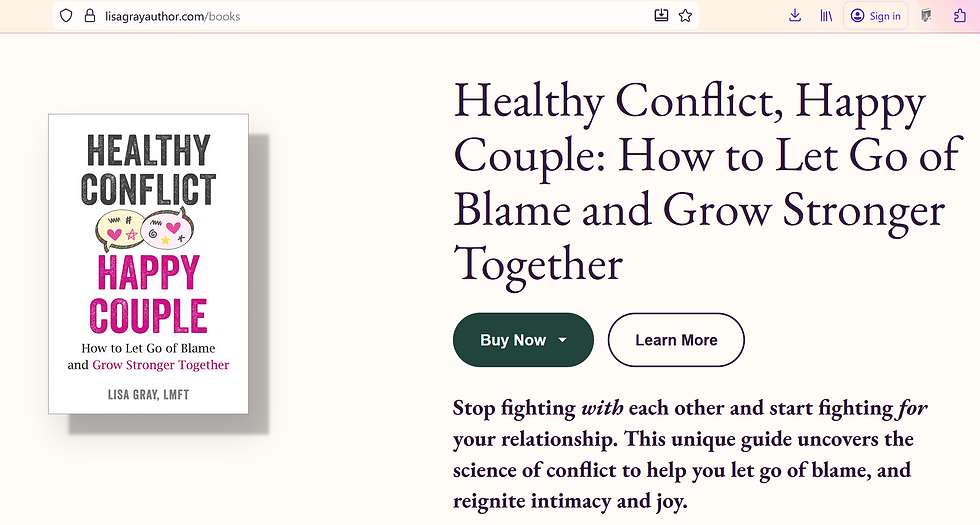
Lisa Gray: Yeah, that's a great question. I don't know if they fight different. I think they fight more. I mean, at least initially, because there's just so many things to negotiate. Um, I find that most people are not that great at conflict, though. Like even before I started specializing in couples with chronic illness like most I mean we don't get a class on it like relationships are the most important thing in our lives and nobody teaches us how to have conflict, and you can't be intimate with somebody without conflict. So my first book was actually called uh, "Healthy Conflict, Happy Couple." So that's like a more foundational piece of work.
Lisa Gray: Um, but I would say the number one issue, I already alluded to it a little bit, like if I could only give one piece of advice to couples for the rest of my life, it would be stop fighting when you're already mad. Because most of us only talk about what we're mad about when we are already activated and in the situation. You've lost control of your creative problem-solving brain at that point. And you are never going to come up with a creative solution if you're fighting when you're already mad about it, you know? So, um I think that especially for people with chronic illness, first of all, that takes a lot of energy to get that activated and mad. It's like schedule times to talk about all the things that need to be negotiated and have those conversations regularly when you're calm, when you're in your best creative problem-solving mind. You'll make a ton more progress if you do it that way.

Alysia Thomas: Yeah, that's, that's solid. That's solid advice.
Stacy Griffin: I really love that you mentioned that because after I was diagnosed with lupus, my husband and I set aside a day every week where we would sit down and have a 'we listen and we don't judge' meeting. I'm going to tell you what really bugged me this week.
Lisa Gray: Awesome.
Stacy Griffin: And I just need you to hear it and accept that it might have been because I was tired. It might have been because I was activated and upset about something that had nothing to do with you.
Lisa Gray: Mhm.
Stacy Griffin: Because when we do that, we know we love each other. And we're doing this because we care about our relationship.
Lisa Gray: Yeah.
Stacy Griffin: And it's like going out in the garden and weeding. It's got to be done if we want to thrive. So we do that every week.
Lisa Gray: Yeah.
Stacy Griffin: Sometimes it is not comfortable. Sometimes it gets us upset with one another.
Lisa Gray: Yeah.
Stacy Griffin: ...but because we're coming from a neutral place, and we do it right after we've eaten a good meal, so we're, we're not hangry, and so because of that I think we're a little bit more constructive in our discussion and it and it is understood that when we are done if we need a minute we'll take a minute to breathe but then we are, we take a moment to be loving with one another. We understand that we will be either laying together and hugging each other, or there will be forehead kisses, or there will be some kind of physical love shown after this so that we, you know, can confirm.
Lisa Gray: Love it.
Stacy Griffin:
Lisa Gray: Yeah. It's like it's like this is top secret, but this is part of why couples counseling works - it's not because the therapist is amazing, not because they tell you all these wonderful things. It's because you set aside an intentional hour every week when you're not mad to talk about stuff. Like I mean you can get that on your own if you just do it the way you just described, right? I mean it's like have the discussion, reconnect. I mean the problem with couples isn't that they've had a thousand fights. It's that they've had the same fight a thousand times, you know? And when you do this week by week, you're you're not doing that. You're clearing out the accounts and starting over and you know, like having more productive discussions. So I wish I could get every single one of my couples to do this.
Alysia Thomas: So good. Well, for couples, would you say that couples that are feeling stuck or they're just kind of exhausted, disconnected, scared to say the wrong thing to each other, what is a small shift that they could make to start rebuilding trust and and and tackling this as as a team?
Lisa Gray: Yeah. I would say if you're really exhaust, if you love each other but you're just really exhausted and this is so hard. I always think about relationships like a bank account, you know, when we meet someone there's a million bucks in the account, you know, so like all the things that happen, they're just like we're writing checks but it doesn't really matter and 10 years later you got nothing and you're still writing checks and that's no good. So, I would say that if you're really exhausted, start with the positive. Like, figure out a way that you can have fun together. You know, like Stacy was saying, like look into each other's eyes, lay on the bed without clothes on, not with any intention of anything else, just to connect. Like, watch a funny show together. Do something that's fun and connecting, because that's what made you start liking each other in the first place. You know, the hard stuff has to be talked about and negotiated,
Alysia Thomas: Mhm.
Lisa Gray: but you need money in the account to do that. And so...
Alysia Thomas: Yeah.
Lisa Gray: ...you can't start with the hard stuff if there's nothing in your account. So, that's what I would say. If you're really exhausted, start with pleasure. Start with something connecting. Start with something fun. Remember why you like each other. Put some stuff in the account. Then start trying to work on some of the issues that have arisen.
Alysia Thomas: Oh, that's good. That's really good.
Becky Miller: Yeah.
Stacy Griffin: Lisa, we would really love to let um, our audience know a little bit more about your book and where they can contact you. So, tell us a little bit about your book.

Lisa Gray: Yeah. So, uh, the book came out in November, thriving in a relationship when you have chronic illness. And it basically pairs the grief stages, which of course we all know are not stages, but like the emotional experiences of grief with the ACT skills. And the intention is that once you get to know the book, it could be mix and match. So, I paired a skill with each stage of grief, but you could decide that a different skill is, you know, good for where you're at right now or whatever. So, after you read it and get used to all the skills, then you can just like use them when you need them. Um, so you can find that at lisagrayauthor.com and then I also have a website lisagraymft.com and I have a team of six therapists who work for me and we all specialize in chronic illness um, in the state of California and can um, there's a website called chronic illness therapist.com if you're not in California. There's a whole listing of chronic illness therapists. Um, and then I'm on Instagram @LisaGraymft. Um, so you can I I put some tips on there and and things that can be helpful. So you can find me there as well.
Stacy Griffin: Fantastic. Thank you. Uh, we we just love giving our audience a chance to connect further when they really, you know, appreciate a guest. So, thank you so much.
Alysia Thomas: Yes...
Lisa Gray: Thank you.
Alysia Thomas: I am sure that we could pick your brain about a million things. We'll probably have you come back at some point if you wouldn't mind because we feel like you are a wealth of information and and especially discussing a subject that affects every one of us living with chronic illness and the people that we love most. And it's it's a tricky balance that we have to always be managing um, taking care of ourselves and our bodies while still loving and sharing our lives with our with our partners. Um, it was I, I needed this today. I needed this specific conversation today because uh I, I...
Lisa Gray: Oh, great. Awesome.
Alysia Thomas: ...just came off of a a long weekend of an unexpected travel for, for a friend's funeral. And um it was it was a lot of two days traveling and then the funeral and and then two days traveling back. And I had a plan with my husband to go out the night that we had this plan on the calendar for weeks. And the night that I was getting back and I was just I was empty. My tank was empty, you know, and I'm pulling into town and I'm texting, I'm so excited to get home. I can't wait. I don't you know he gave me an out because he loves me and we didn't end up going out to do anything, but he was really disappointed. He was really really disappointed, and I felt like a big old jerk, because...
Lisa Gray: Sure.
Alysia Thomas: I wasn't very sympathetic. I wasn't very sympathetic. I, I mean it's it's hard to find like the balance of where am I being selfish and where am I advocating for my health because I was exhausted.
Lisa Gray: Mhm.
Alysia Thomas: Could I have ponyied up and gone and done an outing? Absolutely I could have. It would have just taken from my stores for for the next day or two. You know what I'm saying? And if there's anybody I want to give that energy to..,
Lisa Gray: Yes.
Alysia Thomas: ...it is my spouse. But he will never ask it of me.
Lisa Gray: Mhm. Mhm.
Alysia Thomas: So that is the that is the predicament I found myself in this week where I was saying, "Okay, how do I know if I'm actually being selfish here or if I'm really just advocating for myself?
Lisa Gray: Mhm. That's a tough one.
Alysia Thomas: How do you, how do you, how do I know we need to wrap up here in a minute, but that was something that was weighing on me because I really didn't feel like I was being selfish, but I think he felt that I was.
Lisa Gray: Yeah. Well, I and I think that happens a lot with couples, right? Because because those two things are not necessarily separate things like we both of those can exist. While we are advocating, we are also sort of being selfish from our partner's perspective, because they're not sick and they are going to be disappointed sometimes. And the the statistics show that the happy couples are not the ones who never fight or never disappointed. The happy couples are the ones that know how to repair. So, it's not, you know, your partner is going to be disappointed and feel like you're selfish sometimes. That's just like we're people. You're never going to get this 100% right. You know, the trick is how to repair that and come back together as a team afterwards and reorient yourselves. But if you know, if you're a person with chronic illness, don't think you're going to find some magical pathway where your partner's never disappointed. That is not that does not exist. Yeah.
Becky Miller: Very solid advice. Thank you very much. This has been an extremely meaningful conversation, and we appreciate the work that you do. Um, bringing compassion into a space that can feel very hard for all of us. I mean, I think like Alysia brought it up, even when you have a good and loving partner and you have a good relationship, this is solid advice and we appreciate what you've given us today. We'll make sure to link Lisa's book and website in the show notes so you can continue learning and growing with her. And as always, we'd like to remind you, relationships can evolve, love can deepen, and you are not broken because your body has changed.
You are worthy of joy. Disease does not define your life. You do.
HELPFUL LINKS:
Lisa's Website (you can buy her books here): https://lisagrayauthor.com/
Lisa's counseling website: https://www.lisagraymft.com/
Instagram - @LisaGraymft


Comments