79 - What Is the Best App to Track Chronic Illness Symptoms? - Meet Ethia.io with George & Mara Saldana
Becky Miller: Welcome back to Autoimmune Adventures. If you're living with an autoimmune disease, you already know this truth that managing your health can feel like a full-time job. Between lab work, medications, appointments, insurance, symptom tracking, and trying to remember what you wanted to ask your doctor, it can become overwhelming very fast. And for many of us, there comes a moment when we realize something hard. The health care system wasn't really designed for people managing complex multiple, chronic conditions, especially long-term. And so today's episode is about what happens when frustration of that type turns into innovation.
We're joined by George and Mara Saldana. George is the founder of Ethia, a health tracking platform built after years of walking along the side of his wife Mara through her Crohn's journey, failed biologics, endless appointments, and the emotional weight of navigating all of the things. Mara is going to share her story, and, and they are both going to walk us through how they use platform in real life and how you yourself can get on and start using this platform. So this conversation is about empowerment, about being prepared, and about changing the tone of your doctor visits. And we are excited to get into this. So let's go ahead. We're happy to have you here, George and Mara.
George Saldana: Thank you very much.
Mara Saldana: Thank you for inviting us.

Stacy Griffin: All right. We really want to um, start with your story because then people will understand and have context. Can you take us back to the beginning of your Crohn's journey? What were those early years like?
Mara Saldana: Oh, I could walk you all the way back to the dark ages. Um, when I was a little girl, I remember probably like eight, nine or 10 years old, having blood in the toilet, going to get my mom and trying to figure out the things.
And that landed us um, at Children's Hospital in Philadelphia where I received an IBD diagnosis. And I remember being a little girl sitting in a giant auditorium watching a video of this is like the you know introduction to what IBD is and getting my first colonoscopy and drinking the yummy drinks um, and getting them on um a maintenance drug low-level olsalazine and um, that kicked me into remission. Luckily, I had very mild symptoms at the time and um, really required just an annual followup, not much after that. Then fast forward decades later comes the pandemic, and our bodies and our brains are under so much stress. And I hadn't done any maintenance. I hadn't had any flares that, that I knew of um through all of the years. And here I find myself in my 40s breaking um, just I had OB issues, I had an upper endoscopy issues, and I had GI issues and I knew something was wrong. But with all of these things going on, it was so hard to isolate like what's the issue.
So I go to this specialist, that specialist, and the other specialist. And in the course of a week, I had two surgeries and a colonoscopy to sort all of these things out and came out with a diagnosis of the uh, I think they said ulcerative colitis at the time. And they put me on um, ulcerative colitis maintenance medicine to try and,and steroids to try and get that re that player kicked into remission. That was years ago. I still haven't stabilized in any type of remission state. Um, biologics have put me into a tail spin, or I'm not sure if they're really working. We just kind of get stuck in these constant loops. So, we have um, created Ethia. George created Ethia and that that kind of helped me. I've been ADA, managed ADHD brain, but I just I knew the trends, but I didn't know how to talk about the issues that were these trends. I was methodical with my diet and remembering it and being able to tie my symptoms back to this or that thing, but that wouldn't stay with me for a week or two weeks or a month long enough to be able to craft a story that I can tell to a doctor or provider.
Mara Saldana: And then I'm getting all these labs drawn and that's going into one app. And then I see my primary doctor when I have acute symptoms like migraines to try and get that migraine issue fixed. But is that migraine tied to my Crohn's? Just having all of these day-to-day mini crises to that put me in the seat of being in a waiting room somewhere and needing to prevent that and needing to stop whatever it is that's causing me to end up there. Um, I needed a line of sight and now we have the amazing gift of technology in our world. the AI that can tell that can help us and be the bridge between us and our provider, us and the clinical data. And then also be able to have a system that can say, I see that you didn't get a lot of really good sleep the last week. I see that you switched your medication, or you added a vitamin supplement or that maybe you added a vitamin supplement and now you're in the too high sugar zone, even though you're in the right zone for this particular um, supplement that might assist with your symptoms.
So just sort of having that central point of view has given me peace of mind back and help me to control a little better quality of life having problems now.

Alysia Thomas: I love this. So, I am a woman in my 40s as well, and my brain has gone to shit, and so trying to remember all of the things, all of the medications and all of the appointments and all of the labs and all of the trends and the diet, trying to remember all of that is a immense task to ask of ourselves, I think.
So you had but you had mentioned failed biologics and like constant appointments. That's something that our listeners are going to identify with. They're going to understand that. At what point did you start feeling like the system really isn't built for somebody managing something so complex?
George Saldana: That's a big That's a great question. That's a big one.
Mara Saldana: I'll start with the first biologic. It was April 26 last year, it was two years ago and uh I went in for my first infusion and it was like a TNF biologic and our bodies are I mean molecularly different from the next person. So everything we do to ourselves, it's we're the lab rats and um, and I my arm started itching after the first infusion and I was like, okay, did the doctor tell me to take a Benadryl, Zyrtec, or Claritin or anything beforehand? No. They just were like, "Just drink lots of water. You'll be fine." Okay, I'm not fine. I'm in the hospital now. It's been 24 hours. I'm seeing stars. I, for two weeks after this biologic, I couldn't speak full sentences. When I texted or typed, it was phonetic. It wasn't even spelled correctly. Very fascinating, but not, not the lab rat experience I wanted. Um, and I mean it, it was an acute reaction, an acute adverse reaction to that biologic, and I wanted it out of my system and it took a month there.
People were like, we're not going to do the plasma whatever to get it out of insurance isn't going to rinse this out of your system. You have to just suffer it out and hope, hope that neurologically you come out of this and physically you come out of this a-ok.
Alysia Thomas: Hope, hope that you come out of it neurologically okay?
Mara Saldana: Yeah, because like what the these mechanisms are triggering a neurological response that because they were a, it was a systemic biologic that I was using and it was interacting with mechanisms that interacted and activated for me through my nervous system to my neurons blockers that weren't what I, weren't normal, weren't normal. My co-workers were like, "What was going on with you that week?"
George Saldana: And and the the interesting thing was is that it started with the GI for the infusion, but then two weeks later, we're looking for a neurologist that's competent enough to have this conversation because now all of a sudden, you know, one doctor's like, "Yeah, it's typical. It's not that big of a deal." and the other doctor's like, "Oh, well, wait a second. I'm not sure what are the GI correlations."
So, now we're going to two doctors trying to find the right one. And now it's somewhere between one and the other. And the responses aren't they're not working together, right? There's there's two versions of what they're seeing. And she's battling, like she said, stars and neurological. Lupus might have even come up in conversation.
Mara Saldana: Yeah. My ANA antibodies were up like through the roof. So, I actually had like what's it called? medical like, medicine induced lupus.
Alysia Thomas: Oh my gosh.
George Saldana: So, so now and then that's the two specialists, but then there's also the primary and then there's the ER. So, now you got four different versions and then there's the, the, the actual symptoms that she's battling through that are a bit more acute, not as a result of this of the biologic necessarily, but just part of the Crohn's still being activated and going through.
Mara Saldana: Yeah, it's not stressful at all.
George Saldana: So now you've got another layer and you're thinking how do I, how do we one work that out and two like live a normal life, you know? All the rest of life's challenges still exist right and then you've got this sort of layer sitting on top that was the first biology All right.
Alysia Thomas: That's, that's really messy. That's it's really messy. And when you're working with so many different doctors and you're receiving so much information, differing information, sometimes conflicting information, from these doctors, you like what what is somebody supposed to do with all this?
Mara Saldana: Everyone's like, "Oh, you have an opinion,"
Alysia Thomas: Right? You're just And we know how long it takes to get into some specialists. We know how long it takes to get work done. We know how long it takes to find a treatment plan that's going to work for you. So, it might be just a little off topic, but I have to bring it up because you would be the perfect person to use as an example. My sisters and I have a dream that we're going to open an autoimmune center, and it is going to have all the doctors in one place. And for somebody like yourself, those doctors would be together in a meeting looking at your chart and your issues, your symptoms, your labs, and they would convene. They would meet with each other and talk about you and all in one...
Mara Saldana: Yeah.
Alysia Thomas: ...place at one time so that they're treating your body as a whole and not like, "Okay I'll treat this symptom, you treat that system ,I'll treat that system, on and on. And then you as the patient are like, "What?!" So that is our dream, and I feel like you would be the perfect person to use as an example for that, like how that would benefit you. We would have on-site labs...

Mara Saldana: Absolutely.
Alysia Thomas: We'd have genetic testing. This is something that there's nothing like this out there.
Mara Saldana: There isn't. There isn't. I had um, George actually found the neurologist that was able to get me in the soonest and that neurologist belonged to a practice that was a specialty practice. They had rheumatologists, they had gastroenterenterology, they had cardiology. It, I know it, it's a unicorn practice.
Alysia Thomas: Mhm.
George Saldana: This not this does not exist in in most places. And at the time I was, I was at the end of my rope with with the provider that I had first started this journey with. And um when I did get in to the neurologist very quickly, I might add, I was then able to get into a GI doctor at that practice that took a look at all of the documentation by the, at that first meet and greet appointment. And he said, "You, they've been treating you for ulcerative colitis, but everything clinically here says that you have Crohn's. I'm going to need to do a colonoscopy and confirm if you have Crohn's. So, or col, or ulcerative colitis before we begin treatment. And you know the panel the classic panel of that IBD and inflammation, CBC everything blood work.
Alysia Thomas: Yeah.
Mara Saldana: And um, and it, it is that, that provider just retired, so my heart is broken. So I'm uh I'm kind of just you know adjusting to a new GI doctor at this moment in time. But in that same sort of practice, but what they are missing is the mission statement Alysia that that you and your sisters have is that in service of the patient. It's great to have all of these providers in the hub and I am so blessed, but they're still not talking to each other.
My father, who um he's I call him the father of clinical data, he um back when computers took whole entire rooms and pharmaceutical companies were collecting clinical data, he was one of those people helping to manage it and get it into computers and studies for the very first time. And he and my mother worked in hospital settings quite a bit. Now as I um as I'm starting this journey and that challenge that you that your solution would I would solve for uniting all of the providers under one group they used to have that before technology when my grandfather who was diagnosed with Crohn's in 1970 or I'm sorry he was diagnosed with ulcerative colitis in 1970. Um, when his diagnosis came through the VA would have the GI doctor, the neurologist, the cardiologist, the immunologist, everyone would have a meeting to talk about their shared patients on a standup on a regular basis. There was I can't remember what the name was for it, but then my dad said, but you know, he'll remember. Um, they used to do that.
Alysia Thomas: They had to.
Mara Saldana: It was, yeah.
Alysia Thomas: They had to because they didn't have fax machines yet. They didn't have digital records. They didn't have any of those things.
Mara Saldana: We thought technology was going to solve everything, but now it's all siloed.
Alysia Thomas: I, I mean, it was either that or you send paper photo copies that I, I mean, it was, they had to. And ironically, here we are with all this lovely technology and somehow the problem is still exists. So...
Stacy Griffin: Which is why we're excited that you have created what you've created because technology should be powering us, empowering and it hasn't been for the last 40 years, 45, 50 years, however many maybe we're approaching 60 years at this point. I don't even know.
Mara Saldana: Yeah.
Stacy Griffin: But it's been a while since people have been able to use technology in a way that is going to be beneficial for these complicated scenarios like what all of us have because all of us on this call have had complicated scenarios, including George. So here we are.
George Saldana: Yeah. And it was interesting though the, the mention you brought up biologic and and Mara mentioned the the first round. Um there was another round but the question that came to me was well why that one, right? There's multiple biologics available for that specific condition. Right? Mara had said something interesting which is molec, on a molecular basis we are all different, but they'll still say Crohn', right? So if all five of us here have Crohn's,and they say, "Oh well, here's your Crohn's diagnosis," but then which biologic, which treatment? What, what works, and how do you know?
When we looked at the first biologic, it is not cheap, right? I mean there's you know classifications and billing and codes and stuff that as a patient you're sort of responsible for navigating, which is a lot.
Mara Saldana: And some you get with Medicare and some you don't.
George Saldana: Absolutely And and we went through an exercise with where that was sobering where if you get that wrong, you might be mortgaging a house to get this p, this this treatment that may work, but it's not guaranteed.
Mara Saldana: Oh, yeah. Right. Benefits renewal time period. We're like, is this on the specialty drug list or not?
George Saldana: Right? So, and then it might just be one code change and oops, so we just made a mistake. It was a three out of four, which means it's actually covered versus it's actually $80,000. Right? That, there's a big difference between that little coding change.
But then here comes the second biologic. We're going to try and and as her partner, as a support staff here, I think, well, why that one, right? You got, you missed the first one. Why is the second one the right one? Why not the other five that are available? And it's like, well, it's not the first one, because we don't want that. And so, the second round, it was actually one of the catalysts that made me think about a different approach, where Ethia started coming up. After all these experiences, there was a concept called precision medicine. And I, I've learned about this thing, and I thought, well, that sounds interesting, just those two words.

George Saldana: And then I dug into it and I learned more that like oncology has some applications that are similar to this where they really look at the, the, the body, not the condition, but the body itself. These pathways, these things are activated, these signs that this treatment and this specific condition in this specific patient, this is the right path. And I thought, why don't they do why don't they do that in Crohn's, right? Why not? Well, listen,..
Mara Saldana: Your providers should be.
George Saldana: There should be discussions, right? There should be a better way. It exists somewhere. Why not everywhere, right? Like you you mentioned, you know, um having multiple doctors look at it, having people really think through that. And I and I wondered, well, are we really applying all this knowledge from somebody in the other room down the hall to the patient that's just in this other room, right? Slightly different diagnosis. How can we take a lab, a specialty lab, pull that that that blood sample, and and really see what's out there, really pull it out, right?
I mean, there's a there's so many different treatments out there. So, Ethia started out as sort of that precision medicine approach was if I took Mara's blood sample and I found a specialty lab, could I uncover something that would really point her in the best treatment path, right? Is that biologic wrong or is there right? How do I as a patient, how do we evaluate these things for the right path, right, without having Mara go through the neurological outcomes and the, you know, all those things that we had to battle through. And then I learned and we had conversations with specialty labs and we talked to primary doctors and it's like there's a whole adoption from the medical community that has to happen before they go and kind of think through this. There's, there's, there's pros and cons. And then I think, well, you know what? Actually, the majority of our struggle, yes, the biologic was awful, right? And getting that wrong was terrible. But between the doctor appointments, let's just call it life. Between the ER visits, the doctor appointments, the specialists, there's that life that we have to somehow manage ourselves.
George Saldana: That's that's our responsibility as patients. Stacy, you said you got a folder. I've got a folder. And somehow we as patients sort of have to make sense because can we really expect a doctor - let's just be honest - you've got a 30-minute window at, at best. You go in, they say, " Hey, how you doing?" You say your five minute spiel, they turn around, they try to catch up on patient 1001 that day and look through your their computer of all the notes and then come back and try to hit a bullseye. And I don't think it works for either side, right? I don't think it's fair for them. I don't think it's fair for us. And yet here we go. And that's sort of what we have.
And I thought maybe there's a way we take that folder of history of labs of ER of all the feelings, right? The check-ins every day that we all have naturally. We wake up and how are we doing today, right? How do I feel? How's my mood? How's my body? Then maybe you feel terrible. But in another hundred days of feeling up and down, are you really going to remember the correlation between you felt good, but you also had a Twizzler and red number 40 was or whatever that was, and you don't really think of all those things that actually may happen. There's no chance that I'm going to remember. My memory is terrible. Um, will the doctor really think that's is valid? Maybe. Or will they?
Mara Saldana: They might think it, but they might not say it because, oh, it's not clinically observed that that could be wrong. Like, I feel like there's the providers hold back from us, because they're afraid of liability or risk in the conversation and they they're comfortable with their conversational safety of what...
Becky Miller: I think that, yeah, I think that's absolutely true.
So, here's the part we're excited about. I mean, this has been a great conversation. I think my word, I think our listeners are going to relate to this 100% honestly. But we're excited to offer them what you have, what you've come to show us. Can we jump into the demo?
George Saldana: Oh, you want to do? Yeah.
Mara Saldana: Yeah.
Becky Miller: We would love to do that.
Mara Saldana: What browser?
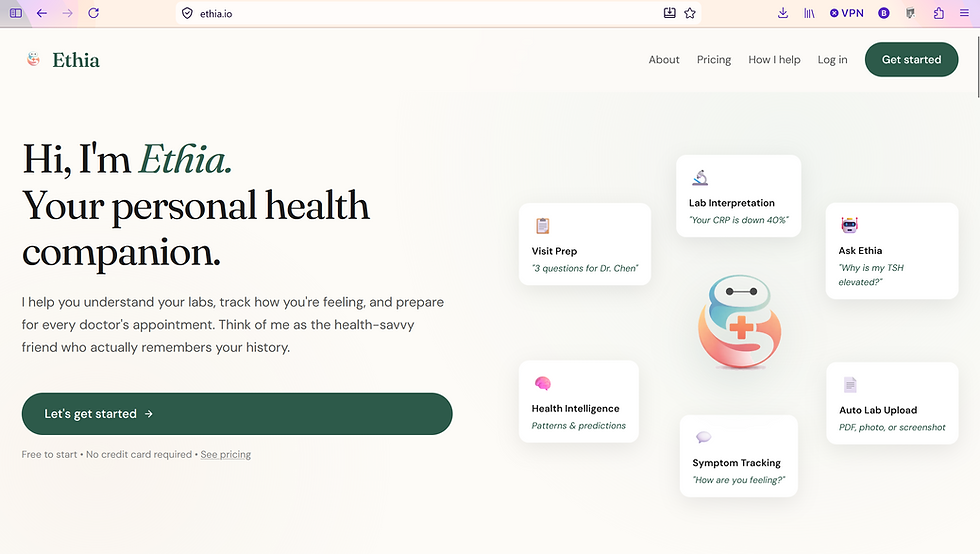
Mara Saldana: All right. So I have just logged into Ethia, and um this is my username cronymuse. So EPA's main point here is to have like sort of a home-based dashboard. This is a browser-based tool um so that when I come home from my appointments I can just log into my my charts download upload and centralize my files right here.
Um, but first you know how are you feeling? Let me track. Well, today I am feeling okay. My symptoms aren't that severe, but I feel pretty awful. Some more detail. Um, my energy level, it's always exhausted. Pain level today. Not so bad right now. Mood. I am loving this moment right now. How well did I sleep? I'm going to say terribly, but I did set my alarm for the eclipse this morning. So, there was that diet food log. Um, I'm actually currently on a liquid diet. For breakfast, I had a vanilla shake.


George Saldana: And, and just to be clear, funny enough, this the diet food log, I actually had conversation with um, the Crohn's & Colitis Foundation, and in the talk that this would be amazing. So section three and section four, which is right below, um yes...
Mara Saldana: I'm not going into that.
George Saldana: ... that's the reality but it's it's the reality of of people's lives, and and some of this um, even as caregivers and I'll take a small side note is that um Mara is an adult and we have children but if the roles were reversed and we were older and our children were younger, I built in a caregiver function in here so that they can also help their caregivers so I can as a patient have uh multiple caregivers of my own, and I can be a caregiver of multiple patients.
Mara Saldana: So George could be my caregiver as well as I can just also be in here too for um children as well.
Mara Saldana: So as a caregiver Yep. So I as a caregiver I would have access to see it but I would be able to use there's an ask AI function there because me that's Mara's partner, I'd be curious to ask questions on her health without having to change her labs or medications. I'm just curious if my own questions to AI like what am I supposed to do? What do I think about this? And maybe just go off into my own tangents without affecting her chats because when she runs her reports on her chats, it's for her. And when I run a report, it's really for m,e because I've been asking these questions and and all the different things. So, I can see my version of hers and she can see her version of hers and we can share back and forth, etc.
Becky Miller: I can see...
Stacy Griffin: I just have to step in and say that's amazing.
Alysia Thomas: Yeah. Yeah. I was gonna say I can see how that is that is just such an amazing feature because whether it is um, you're taking care of your spouse, you're taking care of your elderly parent, or you're taking care of your child who is sick...
George Saldana: Yeah.
Alysia Thomas: ...who needs help, who's got their own stuff. Like this is just fantastic.
George Saldana: There was there was something interesting. It came up and I was speaking to a patient foundation in Canada and it was for Crohn's related and the way they they mentioned that the Canadian process because it's sort of like a a government based thing for adolescence and for for the pediatric population is different. they have a certain hospital that they go to, and when they become 18, they go to a different process to be cared for and there's a lot of difficulties going from one process to the other they just sort of drop off they don't continue with that level of care, because there's a different level of responsibility. So as caregivers, it's almost like what can I do to help my child navigate through there and that that kind of came up in these conversations. So sorry.
Mara Saldana: No it's all good. Um so I'll start some more on some of the the navigating So this there are some key tools here that I want to make sure that we touch on. Um one is work with your care team and engage.


Mara Saldana: So what about visiting a prep report? So, I don't know about you ladies, but um usually I've got 10,000 things on my mind and getting myself to that place of calm where I can get my thoughts sorted um, and know what it is that I want to tell my provider when I'm there that. what is important. What's that thing from 18 days ago that happened that I was like, got to make sure I, I let them know that this weird thing happened or this cause and effect. Um, I can put that into my notes and on my day's check-in that day. And now I can get a prep brief for, oh my goodness, what like I don't have to remember that stress now is off my shoulders when I either when I get to the doctor or before leaving for it, I can just do a PD like oop, sorry, PDF here of all the things that I want to support. And then very quickly it just produces this write up.


Alysia Thomas: Chef's kiss. Chef's kiss. So good.
Mara Saldana: So, yeah it'll say like you know these are, ah, I hit a new record with my calprotectin. So current people will appreciate that.
George Saldana: And, and just to be clear on what you're seeing, what the way I built the platform for us was um, to pull out the things that are they're remarkably different than the regular. So you won't see, she may have you know a thousand labs in there, and you know thousands of markers. The ones I pull that, this, the platform pulls out are the ones that are really high or significant for some reason to call out. So they're out of the range or they're correlated to a feeling that happens that really says you know what there's there's something here that maybe we weren't thinking about or maybe call attention to by a medical professional.
So a lot of this isn't to replace a doctor. It's really to empower the patient to have a better conversation with their medical provider and hopefully that becomes it changes the trajectory to something more positive, right? Just just hey man, if we got five minutes, let's get to the to the valuable stuff and then let's make sure because I'm going to hold you accountable, right? And part of this, you know, we as patients are left figuring this one out, right?
I mean, like I did Dr. Google for a long time and honestly I think a lot of this I want to make sure that the patient and doctor share this and the doctor recognizes yeah they're going to come with a lot of information, and it's on me to do my thing, right? Like I'm trained in this thing, and I want the patient to feel like follow appointment, doctor said call them in two weeks if if symptoms don't change, you get an alert in the platform, "call your doctor." Like, work, use that, right? Don't forget that that exists and a doctor should also expect that is now the patient's going to come back to me in two weeks I need to not think about this. I need to I need this action on my feed.
Stacy Griffin: We, we talk a lot about the importance of remembering that we can respect our doctor but it does not change the fact that we pay them.
George Saldana: Yeah, absolutely.
Stacy Griffin: They are providing us a service, and as such, customer service should be part of...
George Saldana: Absolutely.
Stacy Griffin: ...the experience, and if it isn't, it's time to find a new doctor. And if it isn't, it's time to say things and advocate for yourself and step out and say, "Hey I know you have a short amount of time with me..."
George Saldana: Yep.
Stacy Griffin: ...I want to be respectful of your time these are the things I need to have answers to boom boom boom.
Mara Saldana: All right. We've got over here. You want to go track? I'll got my Google script ready. So, discover. Here we go. Okay. Now, the discover part is great. And we're going to work our way back to the next tab real quickly. Um, but this dashboard basically takes all of your inputs, all of those visits that happen in various different silos, different providers, networks. Now you have a combined view that tells you what what your current flare risk is.

Mara Saldana: What? Sorry, new feature here. Um, what your current flare view is and then can I do a health guideline?
George Saldana: You should. Yeah. Yeah.
Mara Saldana: Okay. And see how the trend has been. We've got symptom check and symptom check and feeling good. Ding, ding, ding, ding, ding, ding, ding, ding. Lab results, markers, flags. Um, and you can get that perspective of all of these inputs. Okay, here are my labs. I've got loaded, loaded, loaded. In these labs, it's scanning for markers. Markers meaning something that goes either up or down and needs to be in a certain way. When it's up, it's a marker that activates something that you probably don't want, or if it's too low, it's activating something else that you probably don't want.
Um, let's go back here.
George Saldana: You might want to go to "Track."
Mara Saldana: "Track." Yeah. Yeah. All right. So this this view will actually take your um, your markers that are north or south a certain way and tell you how it's going to affect your system your your correlation and you can see the how the activity and how the activity of your lab overlays your symptoms.

George Saldana: So on the right side, just to draw your attention, is the abnormality. So is it severe, moderate, mild? How are you feeling? And then the dates. Now this is my attempt to try to see a visual when when we have emotions - and unfortunately professionally there's sometimes there's an emotional response and then there's this data response - and I'm trying to find from my view if was she feeling bad and was there a lab that was also up high just because the red might be she's feeling bad. Does some line or some dot fall above in that severity? And this is where I welcome any feedback from patients to say there's a way I want to see this differently. So just just honestly I always put it out there is that I take a chance at this from my perspective but again 99% of this was built for Mara and patients and for all of us. So it's like how can I actually look at this and see that this is something I need to think about? Out of all the other things that we've done, we've talked about, we looked at a visual easy chart to say oh okay that's that's where these things meet right that's where this thing crosses paths.
Alysia Thomas: Okay, listeners, are you hearing this? Because this gentleman just said he wants your feedback. He wants your feedback on how to make this app or this...
George Saldana: Yes.
Alysia Thomas: ..service be better. Um...
George Saldana: Yeah.
Alysia Thomas: ...that's a really rare thing to hear from somebody who is offering something like this. Like usually it's "this is what you get, you figure out how to use it, good luck." But George is saying this is built to be used. It's, it needs to be. I mean, we want to hear how you can use it...
George Saldana: Yeah.
Alysia Thomas: ...how how we can change it to make it more useful to you. There are so many things you can do with Ethia. It's blowing my mind right now. Um, because when Stacy showed it to me initially, I was like, "Oh, it's just tracking stuff." It is so much more than that. It is so much more than that. This is a comprehensive tool. And I don't think it's a bad thing that it's based off of Mara's health history, because having Crohn's, obviously, there's a lot of GI issues going on. GI issues, anybody who's fighting with autoimmunity is going to have GI issues whether they have the symptoms of it or not.
Mara Saldana: It all starts there.
Alysia Thomas: And yes, and so having the tools that you already have in there, that is going to, that's just going to bring pieces together that maybe others... I mean there's still people that don't talk about the gut brain connection. We know it's there. We know it is real. There are still a lot of doctors that won't talk to that. So, I love that you have utilized AI for this. I have loved that you have utilized um, compiling everything in one place, making it easy to hand over to a doctor as you walk in. Like this is blowing my mind. I, I love this so so much.
George Saldana: Thank you.
Alysia Thomas: As we're we need to wrap up here, as we're wrapping up, we want, we want you guys to tell our listeners how they can learn more about Ethia. Where where should they start?
Mara Saldana: Yes.
George Saldana: Yes. Well, so just one second. Okay. So, so one of the first things is ethia.io, right? You can see it in the top of the screen, ethia.io. Um you can go there, you can register. Please go to the site play around with it try to break it make it work for you if you have suggestions please feed it through I'm I'm more than happy...actually I'm, I'm asking begging. Please be engaged and and let's make something that actually works for us.

And as you can see from this first screen here, this is where I hope we feel comfortable saying, "These are my labs. This is how I'm feeling. These are my doctor appointments." And this whole file here is where you can kind of put, you know, there's like a five-page questionnaire in there. This sort of describes your history of biologics, your history of of what you've been feeling or who you are, the profile. Um, and I think there's 13 I think there's 13 or 14 different autoimmune conditions that I, the platform's built for. So each one of those when you actually complete this health profile should become unique to your specific condition. So I've got Hashimoto's and my wife has Crohn's. So my questions will be specific to me, hers will be specific to hers. And if I've got four, I've got four versions of, you know, the questions specific to the four things I've got. Right? So this should be when you come here, um, it should be supportive of who you are, right? As individualized or as comp complex as we all are, it should be there. And you mentioned something about, you know, all the different doctors and, and compiling it.

George Saldana: I built this ask AI function. If you could scroll up because that standardized level of care, a doctor is not a doctor is not a doctor, right? Not every one of those will give you the same level of responses, of experience, of compassion for what you're going through. And this may not give you that much compassion, but the way I've built this, and I've tried to, is to not replace a doctor, but to empower us to say, can I get more information? Can I get a a more standardized - AI is great. It's not the answer fully yet. Maybe it will be one day, but right now it's an empowering tool to start asking questions instead of searching on the wild west of Google or the internet. At least now it's taking consideration you, your background, your labs, your markers, your, you know, your check-ins, your feelings, your diet, and saying, "Okay, let me ask questions as if I have all that in there." And this thing will do that for you a little bit more standardized.
So, please, like I you guys have been all saying, thank you so much. And, you know, sign in, sign up, register. Uh, if it breaks, let me know. I'll fix it. Um, please try to break it. Treat, please make it as as unique and personalized as possible. And that's what I'm hoping this this will do for everybody else.
But but I will say that I will. All your listeners can have the free plan, right? So I can I can put this in the back end. So if your listeners are saying, "Hey, I really want the free plan. Just just send me a note and you'll see I don't need first name, last name. This is all HIPPA compliant, So I don't want to know personal information." Um an email would be sufficient or a username would be sufficient. Say, "Hey, I registered. I got the free plan, but I'm a listener of the show, of your podcast, and I'd like to to explore all the all the features. Okay, no problem.
Stacy Griffin: That's fantastic. Thank you so much. We have loved this conversation. It's so.. just so much. It reminds us of something that we talk about a lot, which is empowerment doesn't mean that we have to do everything by ourselves, and I love that so much. It means that you have tools. It means that you walk into the room prepared. It means that your story is backed by data, not dismissed by emotion. And for so many of us living with autoimmune disease, that's the most exhausting part. It isn't just the symptoms. It's that mental load that keep, of trying to keep track of absolutely everything and feeling like if we've dropped the ball, no one is going to be able to keep track of us. And that's frustrating and hard.
So, what I love about this story is that it started in frustration and in watching someone that you loved struggle and instead of accepting the system as it was, you built something to make it work better. So, I love that the two of you did this. It's amazing.
If you've ever walked out of an appointment wishing that you had said something differently, or if you've ever forgotten a symptom until after you left the doctor's office, or if you've ever felt dismissed because you couldn't prove what you were feeling, this episode is your reminder that experience matters, your data matters, and you deserve support. So, thank you so much both of you for being here with us and sharing not just a platform but your story. We love the stories.
George Saldana: Thank you so much.
Stacy Griffin: And for all of our listeners out there, remember you are worthy of joy. Disease does not define your life. You do.
HELPFUL LINKS:
Visit https://ethia.io/ to register.
To offer feeddback or request the free trial for being a listener of Autoimmune Adventures, click the round blue button with a white conversation bubble in the right bottom corner. You can also use this button to offer feedback or suggestions on things you would find helpful to have included on the site, or if your disease is not listed in the registration pull-down menu, you can request it be added to the app.


Comments